
Quick answer
F(n)/F(n-1) approaches φ≈1.618 as n grows. Binet links powers of φ to F(n).
Formula
- φ = (1 + √5) / 2
- lim F(n)/F(n-1) = φ
Introduction
Fibonacci numbers and the golden ratio appear together in art history books, biology posters, and advanced algebra lectures. Calculations of such numbers is not easy but a percentage calculator can help you without making a mistake. The link is numerical, not mystical.
As n increases, dividing one Fibonacci term by its predecessor approaches φ, the golden ratio. Early ratios are close but not exact; later ratios stabilize.
Review Binet's formula in the Fibonacci formula article if you want the algebra behind the limit.
Refresh the Fibonacci sequence definition if you need indexing before you form ratios.
You can compute both terms for any ratio using the home calculator.
Relationship explained
Define r(n)=F(n)/F(n-1) for n≥2. The sequence r(n) oscillates above and below φ while edging closer.
Golden rectangles use side ratios near φ so that removing a square leaves another golden rectangle.
Spiral models in nature often use consecutive Fibonacci counts because packing efficiency improves.
Mathematical significance shows up in continued fractions and eigenvalues of related matrices in advanced courses.
Convergence pattern
- F(10)/F(9) = 55/34 ≈ 1.6176
- F(20)/F(19) = 6765/4181 ≈ 1.6180
Use the calculator to fetch numerators and denominators separately for any n you choose.
Plotting r(n) against n in a spreadsheet reveals damped oscillation toward φ.
Programming loops for terms follow the same recurrence whether you store every value or only the latest pair.
Tables for small n are enough to start ratio experiments before you request very large indices from the tool.
Estimate φ from Fibonacci numbers
- Pick large n Bigger indices give better ratio estimates.
- Compute F(n) and F(n-1) Use the home calculator twice or store prior term.
- Divide Use double precision only for exploration, not proofs.
- Compare to φ 1.6180339887 is a common textbook approximation.
Visual classroom activity
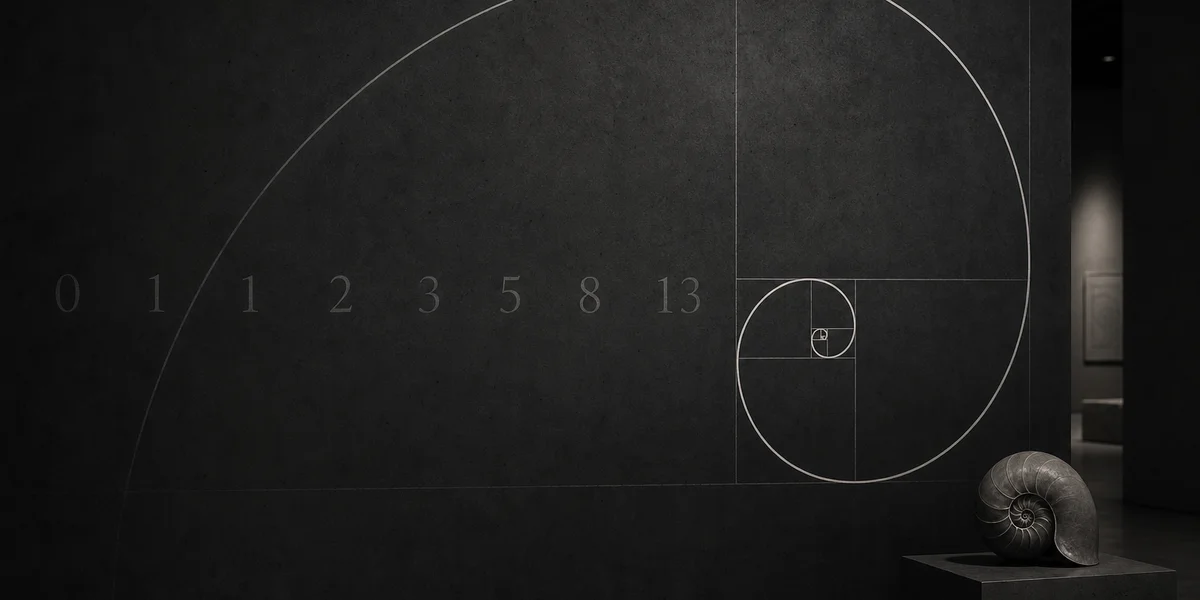
Draw squares whose side lengths are consecutive Fibonacci numbers. Arrange them in a spiral layout.
Students see how the proportions approach φ even though each square has integer sides.
Discuss why φ is irrational while every Fibonacci number is an integer.