
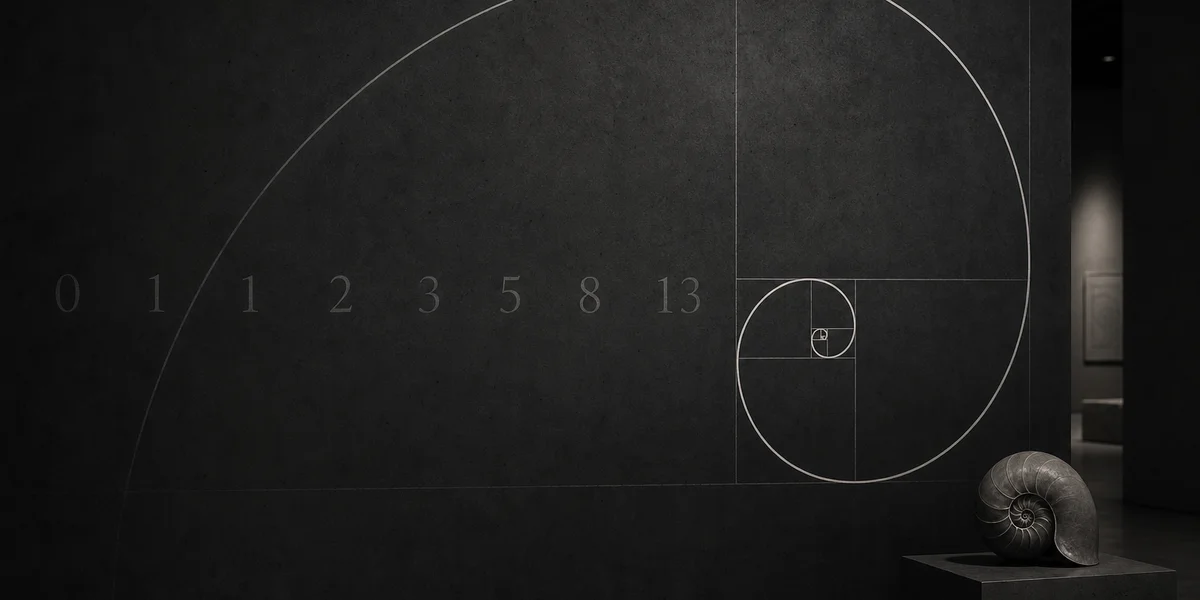
Quick answer
F(0)=0, F(1)=1, and F(n)=F(n-1)+F(n-2) for n≥2. Each new value is the sum of the two terms immediately before it.
Formula
- F(0) = 0
- F(1) = 1
- F(n) = F(n - 1) + F(n - 2)
Introduction
The Fibonacci sequence is an integer list that begins 0, 1, 1, 2, 3, 5, 8, 13, and continues without a fixed upper bound. Students meet it in algebra, computer science, and puzzle books because the rule is simple to state but rich in consequences.
Before you calculate a single value, you should know what the pattern means. A Fibonacci number is not just any number that appears in the list; it is the value at a specific index n when you follow the standard recurrence from agreed starting points.
When a problem asks for the 15th Fibonacci number, you must know whether the author counts from F(0) or from the first 1 in a list that omits zero. Our home calculator uses F(0)=0 and F(1)=1, which matches most programming libraries and the Fibonacci formula used in coursework.
Real applications range from counting rabbit pairs in historical puzzles to modeling seed spirals in sunflowers. Traders also borrow ratios derived from the sequence, though that finance angle is separate from pure integer terms.
The sections below walk through definition, meaning, history, and applications so you can connect vocabulary to the tool on the home page.
Definition, meaning, and pattern
Formally, the Fibonacci sequence is defined by two base cases and a recurrence. For every integer n ≥ 2, the n-th Fibonacci number equals the sum of the two preceding Fibonacci numbers.
The Fibonacci number pattern is additive: each step only looks backward two positions. That local rule creates global growth that accelerates faster than a straight line but slower than pure exponentials with base 2.
Meaning in context matters. In combinatorics, F(n) can count ways to tile a board or paths in a grid. In nature, spirals often show Fibonacci-like counts because packing efficiency favors those arrangements.
If you want worked values next, the Fibonacci sequence examples article lists the first 10 and first 20 terms in tables you can compare with calculator output.
Starting values and generation rule
- F(0) = 0
- F(1) = 1
- F(n) = F(n - 1) + F(n - 2) for n ≥ 2
The generation rule is deterministic. Given F(0) and F(1), there is exactly one sequence that satisfies the recurrence.
Some textbooks present the list as 1, 1, 2, 3, 5 without mentioning F(0). That is still the same pattern after a shift in index, but it changes which n you plug into a calculator.
Write the first few terms whenever you learn a new definition. Seeing 0, 1, 1, 2, 3, 5 on paper prevents off-by-one errors later.
How to read and extend the list
- Anchor the bases Write F(0)=0 and F(1)=1 at the left of your row.
- Apply the recurrence For each new column, add the previous two entries. Say the values aloud: "sum of the last two."
- Label the index Under each term, note n. The subscript is the index you would enter in the home tool.
- Stop at your target When n equals the index requested in the problem, that column is F(n).
- Verify electronically Enter the same n in the home calculator to confirm manual work.
Worked example: F(8)
Build the chain: F(0)=0, F(1)=1, F(2)=1, F(3)=2, F(4)=3, F(5)=5, F(6)=8, F(7)=13, F(8)=21.
The eighth index in this zero-based table is 21. If a word problem said "the ninth Fibonacci number" while counting 1, 1, 2 as the first three, translate the wording before you choose n.
Checking on the home page with n=8 should display 21 with comma formatting disabled for small values but active for larger results.